
Spring 2026

— Thomas C. Stakem, Jr., CFA, Senior Vice President
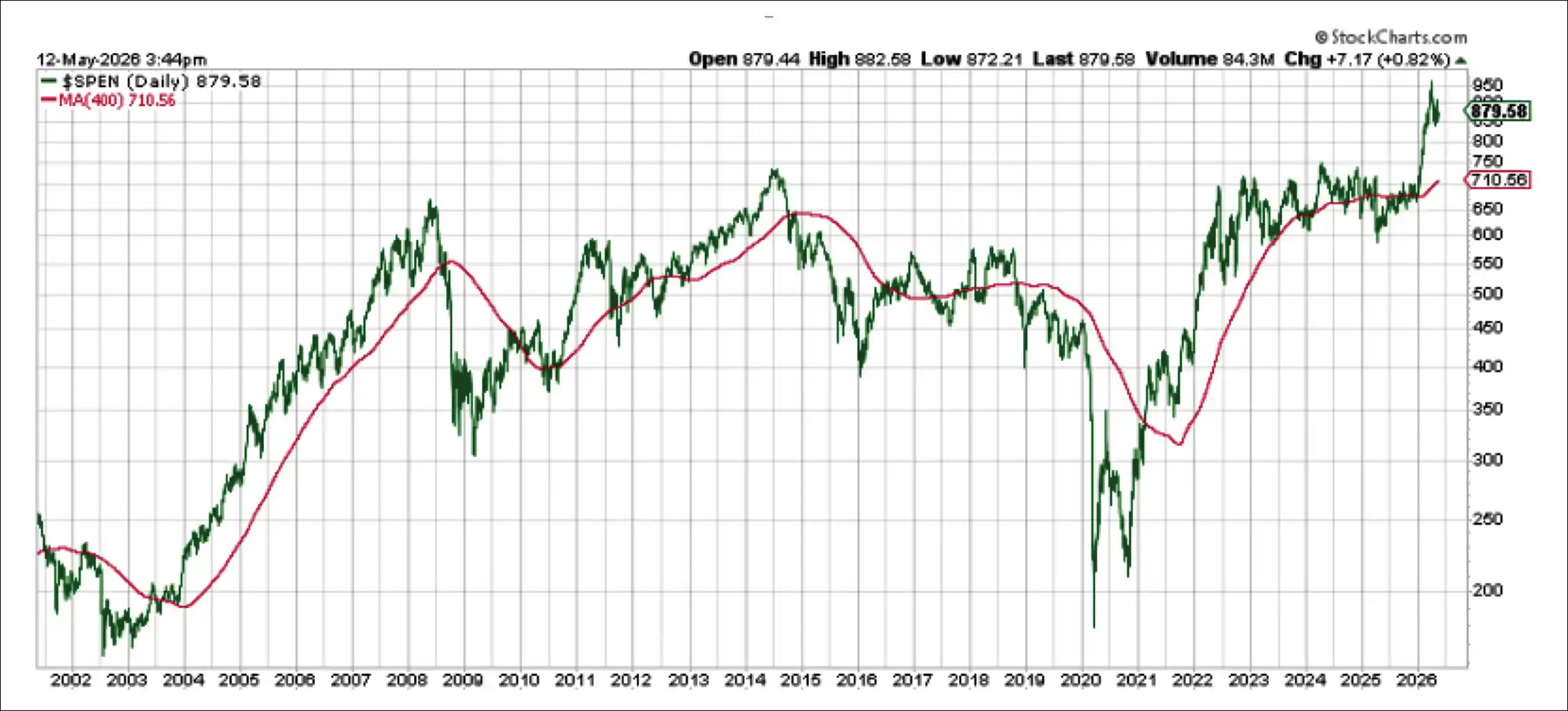
Is there a more bullish condition than a stock price or an index price breaking out to all-time high ground on an absolute price basis? Figure 1 shows twenty-five years of absolute price history of the S&P Energy sector (4% of the S&P 500 as of 4/30/26) The decisive price upthrust shown in Figure 1 occurred a few days after Venezuela’s former President Nicholas Maduro was captured and brought to the US to face drug trafficking and weapons charges. This was followed by the late February military action in Iran by the US and Israel.
Figure 1: $SPEN S&P 500 Energy Sector Index
Sources:-StockCharts.com
This has been a very curious reaction by investors, as there were early fears of US policy-directed capital investment in revitalizing anemic Venezuelan oil production (sub 500,000 barrels per day, or b/d) back to the glory days of 3.0-3.5mm b/d in 1970 and then again in 1997-1998. Widespread fears of a 3-4mm b/d International Energy Agency (IEA) forecast oil supply glut would only be exacerbated by this effort. Less than two months later, one of the world’s greatest “pinch points” would be on the lips of billions of people around the world: the Strait of Hormuz. About 20 million b/d of crude oil and refined products passed through the Strait on a daily basis prior to the beginning of March. (Other important items also passed through, as we find out on a daily basis, including fertilizer and sulfur). Hundreds of tankers are clogged in the Persian Gulf, which has led to reduced supply, shut-in production for lack of an export outlet, and an IEA/US commitment to release up to 400 million (will be closer to 300 million) barrels from the Strategic Petroleum Reserve (SPR).
Modeling out the interplay between all the variables—unsatisfied demand, reduced supply, shut-in OPEC production, and SPR inventory releases—the daily net loss ranges from 10-15 million b/d or close to 100 million barrels per week. Thus, should these conditions last more than four weeks, the negative price effects really compound because the SPR releases will have been exhausted. [We are now in week 11 as of this writing.] This is the basis for some forecasting $150/bbl crude oil prices by June.
Estimating the duration of a 100-million-barrel weekly deficit coupled with the damage to oil-related assets in the wider Persian Gulf region is what traders are attempting to price out on a daily basis. Generally speaking, Brent and West Texas oil prices have been as high as $115-$120 per barrel (bbl) and as low as $90-$95 per bbl. While it is impossible to calculate exactly what oil price energy stocks are discounting at any specific point in time, a comfortable assertion would be that something closer to $70-$75 per bbl is being discounted, not anywhere near $90-$95 per bbl.
Looking for Direction
With all the key variables (supply, demand, inventories, price) “up in the air,” analysts and investors look to the futures market for possible guidance and direction. Even though this is understandable, futures markets are notoriously unhelpful forecasting the price levels one wants to be more confident in before making investment decisions. The reasons are obvious: unexpected developments, wars, embargoes, Strait closings. Wall Street oil analysts base their financial forecasts on strip oil prices, which are calculated using monthly future prices. It has the allure of precision and insight, but its track record of success is just not there. Yet, it is the ritual that everyone uses.
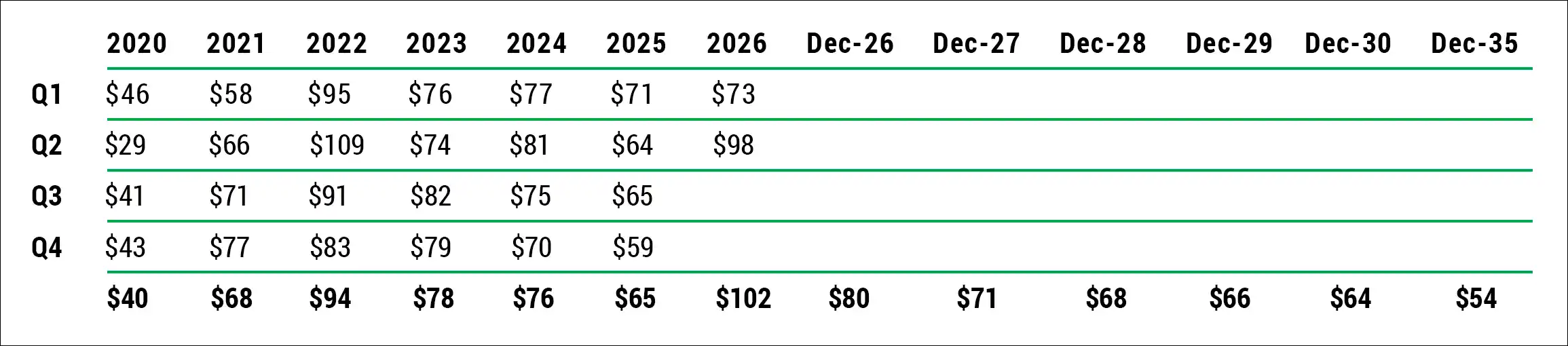
To shed light on this very important issue of what price signal the capital markets should be paying attention to, Table 1 may provide useful perspective. Both US and Brent crude oil prices were $115-$120 per bbl intraweek before settling at $102-$108 per bbl on 5/1/26. Prices have risen another $5–$10/bbl since then. Table 1 shows that prices beyond today are backwardated
(from $102/bbl June 2026 to $54/bbl December 2035). This is very counter-intuitive if one holds (as I do) the view that incremental supply growth will be less than incremental demand growth over the balance of the decade. Needless to say, any oil company’s earnings per share (EPS) estimates would be unimpressive if the above future prices were used to model EPS over the balance of the decade. That’s because embedded depletion would prevent volume growth from offsetting the obvious deflation in oil realizations. As shown Table 1, the Q2 2026 average (only 22 data points) price has averaged $98/bbl just below the Q2 2022 average of $109/bbl.
Table 1. US Crude Oil Price per bbl (Averages & Dated Future)
Source: Woodstock Corporation
Higher Priority on Energy Security
While the Strait of Hormuz episode may fade quickly, the lingering effects will be that energy security for most countries in the world will have a higher priority. This should inspire a desire for more self-sufficiency and less dependence on unreliable supply sources. All this should reinforce the relative attraction of the US economic outlook. Our near self-sufficient energy profile confers a significant, growing and enduring economic advantage over our trading partners.
If there is one message in Figure 1, it is that oil stocks are discounting a very different future than what was consensus late last year or the downward trend in oil futures prices. The S&P 500 Energy sector depicted above is clearly discounting a much brighter oil price future than what the crude oil futures market is currently reflecting. There really was no 3-4 million b/d glut on the horizon late last year or nowand a drilling boom will be required to generate the new oil supplies required to meet incremental demand. Minimal spare capacity within OPEC+, plateauing/stagnating oil production profiles in the US and Russia, and the remedial work likely to be required to restore production in several Persian Gulf OPEC producing countries is likely to keep the physical supply/demand balance snug for several quarters into the future. With global inventories being drawn down (including the SPR, which will need to be replenished), this portends a healthy oil price backdrop as well as favorable refined product margin outlook.
Apart from relaxed leasing and environmental regulations, there has not been a coherent US energy policy. Trumpeting lower gasoline prices and a “drill baby drill” slogan is not an energy policy and has been greeted with a yawn from US oil producers. Encouraging majors to spend capital in revitalizing Venezuelan oil fields while promising lower gasoline prices here at home sends a very confusing message that is reflected in flat-to-down drilling activity and little enthusiasm for higher spending in the US.
Blended US refiner oil input costs are up an estimated ~$55 per bbl ($115 vs $60/bbl) from year end, with retail gasoline prices up ~$1.10 per gallon. Current crude oil costs would likely require another $0.25 per gallon to reach historical gasoline price/crude equilibrium by my calculation. This would result in a $4.25 per gallon average US retail gasoline price. In the extreme case of $150 per bbl crude oil, the retail gasoline price would have likely risen to $4.75-$5.00 per gallon, $0.75 to $1.00 per gallon above the estimated April 2026 level.
The drilling boom case would have to be predicated on sustainable higher oil prices, which would range from $75 to $90 per bbl with triple-digit prices certainly in prospect over the balance of the decade in the optimistic case. Short-cycle drilling would rebound in the Permian Basin, where the highest and quickest incremental volumes reside. Production growth would be visible within 12 months from the oil shales but offshore drilling would take five to seven years. This all assumes that industry cash flows would be rising for most producing companies, assuming 100% of their production was not hedged at lower prices (Q4 25 $60-$65 per bbl level). It will be interesting to see to what extent activity and confidence picks up in the second half of 2026 and 2027.
Having the military objectives achieved and the maximum pocketbook pain absorbed within months would still provide time for the $14-$17 per bbl six month oil price decay indicated by the futures curve to impact voter pocketbooks and psychology. That would be the “win win” the president would like to achieve over the next three quarters. Investors will be assessing the duration of the Straits being closed for how much inventory needs to be replenished, at what rate of global production and at what price. It will likely be at a price well below $125 per barrel, but investors will be happy with $75–$90 per barrel crude oil prices and $3.00–$3.50 per gallon gasoline.